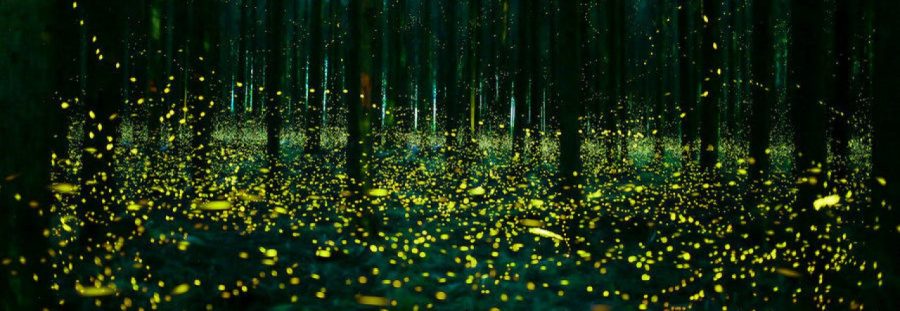
The firefly genome contains coding for the protein Luciferase, which allows some, but not all, members of most firefly species to glow at night. Genes are segments of DNA that encode for proteins. A segment of DNA is transcribed into RNA, then translated into its respective protein to be modified and used by the cells. This movement of genetic information is called the central dogma. DNA is the starting point of this information flow because it holds genetic information in sequences of nucleotides and because of its notable stability. DNA of an organism is organized into different numbers of chromosomes that are tightly packed within the nucleus of a cell.

Not all genomes are the same. Genes between individuals of the same species can vary at a single base pair to the entire gene having different patterns or sequences of base pairs. The amount of genetic variation between individuals in a species or population can be quantified in two ways: ploidy or the F-test statistic (Fst). Ploidy is the number of sets of chromosomes in an organism, whereas the Fst compares variation between two subpopulations. The higher the Fst value, the more variation exists between the two subpopulations. For example, a species of fireflies in which fluorescence is exclusive to males will have a higher Fst value than a species where both males and females glow.
The majority of DNA in the genome is non coding, or “junk” DNA. Despite this misleading nickname, it has important functions for the genome. Regulatory elements aid in transcription by promoting or inhibiting the creation of RNA. For example, some regulatory elements can shut off the Luciferase expression in cells that are not needed for glowing and other regulatory elements can increase the transcription and translation of the luciferase gene in the light organ of the firefly.
Another classification of DNA is transposable elements. These regions of the DNA are able to move, potentially copy themselves, and insert themselves into other areas of the genome. This can either help, hurt, or have no effect on the organism. When looking at the DNA you might expect that as an organism becomes more complex, it would have more DNA stored in a larger number of chromosomes. However, this is not the case. For example, a koala usually has 16 chromosomes whereas a firefly usually has 19 or 20 chromosomes.
The firefly is a diploid organism, meaning that it contains two sets of each chromosome. The exact number of chromosomes a firefly has varies depending on its sex and species. Normally, fireflies carry two pairs of nine chromosomes and an extra sex chromosome or two, adding up to 19 or 20 chromosomes. Fireflies are members of the XO sex determination system which means that males have one X chromosome where as females have two X chromosomes. There are some species of fireflies in the subfamily Luciolinae where males have 15 or 17 chromosomes. In another species within the subfamily Photurinae, males have 20 chromosomes and females have 21 chromosomes, resulting from a singular extra called a ‘B chromosome’ that contains some extra genes, which will be explained later.
The genome of the firefly species can vary from around 500,000,000 base pairs to 1,300,000,000 base pairs. Even within the same species, such as in Pg.decipiens, the genome between individuals can vary as much as 300,000,000 base pairs. The genome of an individual firefly contains many repetitive sequences. This occurs in as low as 10% of the firefly species Photinus sabulosus, but it can also go as high as 56% in the species Photinus obscurellus. Repetitive sequences have many purposes, such as providing extra dosage or copies of a gene to protect the organism against random mutations in one of the genes and to provide more genetic variation between individuals of the same species.
It is thought that much of the genome size variation in firefly species can be attributed to B chromosomes. B chromosomes are nonessential chromosomes that are composed of repeating sequences of DNA that have multiple forms across a wide variety of species and populations. These B chromosomes are responsible for the variation in genome size in a number of species such as certain strains of rice and grasshoppers. The extent to which B chromosomes play a role in the variability of firefly genome size is not entirely known but is a topic of current research. Another hypothesis of current investigation in the variability of firefly genome size is the recent development of triploid genomes in some females. Typically, organisms with triploid genomes are sterile. It is not known if these firefly species with triploid genomes are sterile or not, especially since all observed triploid individuals were female.
Heritability can be quantified into broad-sense and narrow-sense heritability, which can further be used to determine the phenotype of offspring based on the average phenotype of the parents. Broad-sense heritability quantifies the resulting phenotype from all heritable elements. Narrow-sense heritability uses additive heritable elements. Narrow-sense heritability is used in the Breeder’s equation to determine the phenotype of the offspring of two parents. The Breeder’s equation is particularly practical in predicting the outcome if one bred two organisms together. While intentionally breeding fireflies for a specific trait is not commonly done, there are people attempting to repopulate certain areas in the U.S. with fireflies! On the other hand, researchers take advantage of the luciferase gene to make other animals glow, and the Breeder’s equation could be applied to predict the brightness of an offspring’s glow.

 Lampyridae - Fireflies