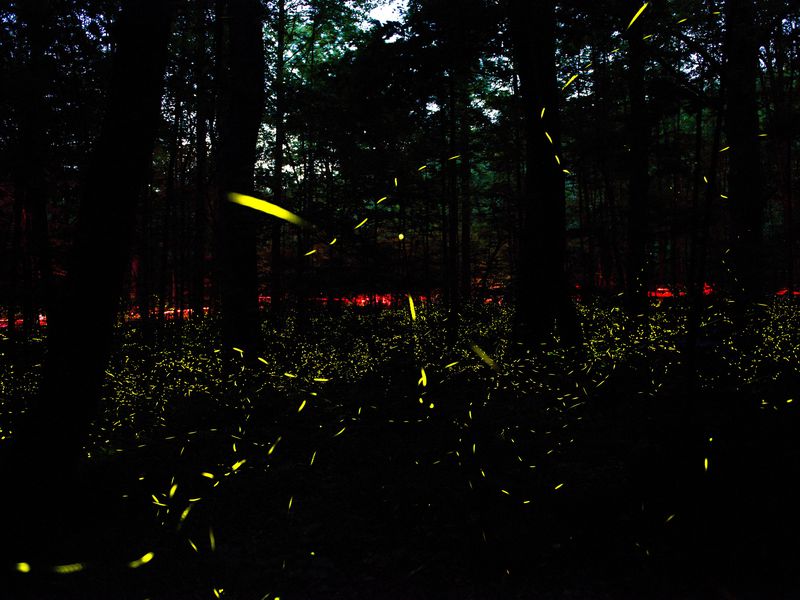
Fireflies have a limited range of habitats that they are able to thrive in. More technically, a niche is the range of environmental conditions, both biotic and abiotic factors, that a species can tolerate. Each species has a fundamental niche and a realized niche. Fundamental niches contain the entire range of conditions that a species can thrive in. For example, the fundamental niche for fireflies is any warm and wet environment. Realized niches are more specific and are the habitats that we find the species in. Fireflies are found in damp areas such as forests, streams, or marshes.
Suppose you want to attract fireflies to your backyard to entertain your family. First, you would have to make sure your backyard is a suitable environment for fireflies. In order to do so, you decide to use ecological niche modeling, which is the process of determining suitable habitat conditions for a species. If you lived near a stream or have a moist environment in your backyard, you might either find fireflies or be able to attract them! Your backyard would then be part of the ecological envelope, or range of ecological conditions that is assumed to be suitable for fireflies.
There are many characteristics of how a species distributes within a niche. First, the geographic range uses the realized niche to draw a boundary around where we find a species. However, not every square mile of the geographic range will contain the species, it’s just the range where you might find the organism. Fireflies can be found almost everywhere in the US and Canada as seen in the following map:

The geographic range of fireflies is the entire region shaded any color of green. This range can be described as cosmopolitan, or a large geographical range. In opposition, species that are only found within a limited range are called endemic. The “blue ghost” species of fireflies can be considered endemic since they are only found in the Carolinas in the United States.
The darker shaded regions on the map above have a higher abundance and density of fireflies. The abundance of a species is the exact number of fireflies found in that species. The density of a species is how concentrated individuals are in a given area, or number of individuals per unit area. The Great Smoky Mountains along the Tennessee – North Carolina border in the United States contain a high density of fireflies. These fireflies can even sync their flashes together!
Abundance and density are related to geographical range via resources available and utilized by each individual. The larger the geographical range, the more species (abundance) that range can hold due to more resources available for the species. Similarly, the smaller the body mass, the less resources each individual uses. This allows for more individuals to thrive in a given range. One time on a service trip to Kentucky, my group spent an evening catching fireflies and keeping them in a jar. We were able to keep over 100 fireflies alive for a couple days before releasing them within the jar since adults do not eat much. Fireflies are able to thrive in a very small density.
The density of a species does not tell us the full picture. The individuals might not have equal dispersion. They could be clustered in a few small areas or spread out evenly or randomly. For example, if fireflies existed in a forest that also contained a swampy area, we might expect the dispersal to be clustered with the majority of fireflies living in the swampy area.
Dispersal describes the movement of individuals from one area to another. This feature is responsible for gene flow, but only as long as individuals can survive while moving to a new habitat. Habitat corridors are stretches of suitable habitat that increase the chances for dispersal. An example of this might be a stream connecting two ponds. Fireflies living around the pond upstream can disperse downstream to the other pond!
Scientists have multiple ways of estimating the density of individuals in a given habitat. Area-volume surveys select a square boundary, count all of the individuals found in that boundary, and extrapolate that number to cover the entire geographic range. Line-transect surveys draw a line and count individuals along that line. This method is probably best for estimating population sizes for fireflies since they move around a lot. A last method for estimating population distributions is mark-recapture surveys. Scientists capture an individual, attach a marker such as a GPS, and track the individual over time. This method is used for larger organisms such as sharks.
Not all habitats are equal in quality. Habitats can be considered good in quality when they contain abundant resources, limited predators, and spaces for shelters. The ideal free distribution describes how many individuals can thrive in a habitat depending on its quality. High quality habitats can host more individuals than a lower quality habitat. If there are too many individuals in a high quality area, it would be worth it to a few individuals to disperse to a lower quality habitat that has not yet been inhabited by members of that species.
Three metapopulation models describe the dispersal of individuals based on habitat quality. In the basic metapopulation model, patches of suitable habitat exist within a matrix of unsuitable habitat. In this type of model, we do not expect much dispersal since each good habitat is of equal quality. In the source-sink metapopulation model, patches of varying quality are embedded in a matrix of unsuitable habitat. Now, this model takes into account different types of suitable habitat. In this model, more dispersal occurs from the source (highest quality habitat) to the sink (lower quality habitat but still suitable) than vice versa. Let’s return to the stream connecting two ponds. If the pond downstream was smaller than the pond upstream, we would expect more fireflies to travel downstream than upstream. Lastly, the landscape population model adds varying quality to unsuitable habitats. The amount of dispersion in this model is relatively similar to the source-sink model, but more routes are available from the source to the sink since not every unsuitable habitat is of the same quality.
 Lampyridae - Fireflies