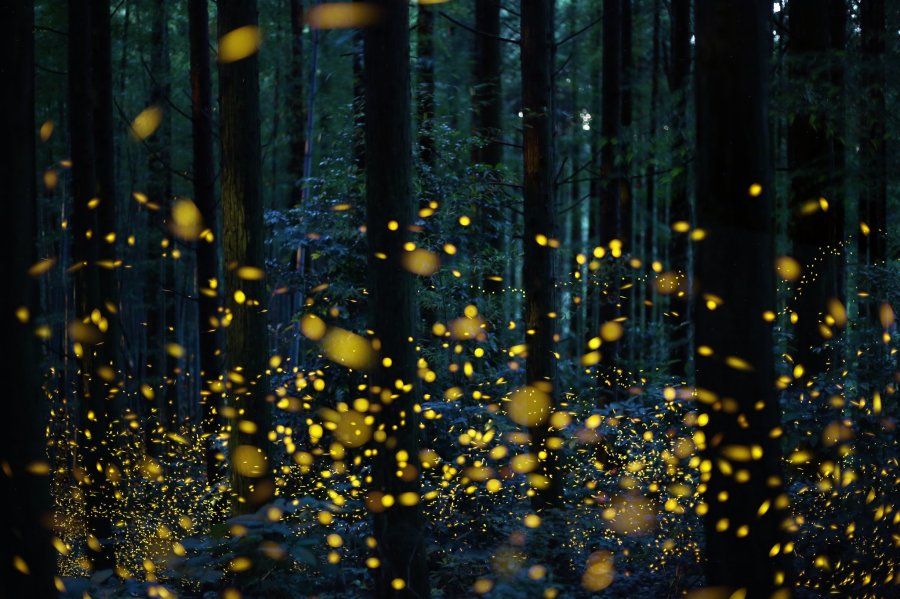

Fluctuation in population numbers has many causes. Populations could increase or decrease due to abundance of food, disease, environmental factors, predation, or competition. How much each population varies due to these factors also varies, depending on body size and plasticity. Larger species do not vary as much but smaller species, such as fireflies, have significant variation. Firefly population sizes vary from year to year depending on the weather (fireflies prefer moist environments), availability of food (fireflies are predators that eat small insects, snails, and earthworms), and availability of habitat (fireflies prefer places to protect themselves during the day).
There is a limit to how many individuals of a population a certain habitat can hold. An overshoot occurs when a population grows beyond its carrying capacity – the maximum number of individuals that habitat can hold. A die-off is when a population declines substantially below its carrying capacity. A population tends to grow significantly when there is an abundance of food and little to no predators. For example, if the population of frogs or birds that prey on fireflies experienced a die-off, we would expect an increase in size or maybe even an overshoot of the firefly population. A population cycle is the regular oscillation of population size over time and consists of growth and die-offs.

Sometimes, a population may not respond fast enough to changing environmental conditions. This results in delayed density dependence, where a population responds to environmental conditions at a time A when the carrying capacity is higher but when the offspring are born at tie B, the carrying capacity might be much lower, resulting in an overshoot and a die-off. This can be modeled by slightly editing the logistic growth equation adding the length of the delay.
Depending on the growth rate and the length of the delay, oscillations either continue to happen or dampen. Oscillations occur because of biological reasons. Some species have the ability to store resources which allow them to grow beyond carrying capacity. Oscillations are dangerous for small populations as they are more vulnerable to extinction due to random chance events.
Stochastic models incorporate the random chance events in population growth rate into growth models. Demographic stochasticity involves random variation in birth and death rates in individuals while environmental stochasticity includes random variation in birth and death rates due to the environment. A demographic example would be differences in survival rate between individual fireflies. An environmental example would be if one population of fireflies had access to insects as food while another population does not.
Not every available habitat suitable for a species is occupied. Whether or not a patch is occupied depends on the size of the patch, distance between an occupied patch, and the availability of the species to move between patches. This is known as the theory of island biogeography. Larger patches near occupied patches have a higher probability of being occupied. Smaller patches have less resources than larger patches. Individuals that attempt to migrate to a patch that is farther away takes on more of a risk while migrating. It is unknown whether or not firefly populations can migrate but it has been observed that when a field that contains a firefly population gets paved over, the fireflies do not migrate, they just disappear.
 Lampyridae - Fireflies