Not every organism exists peacefully. It may not be obvious, but most if not all creatures compete with other individuals for resources. Competition is a negative interaction between two or more individuals that depend on the same limiting resources to survive and reproduce. Not every individual gets the same amount of resources. Competition can either be intraspecific, between the same species, or interspecific, between different species.
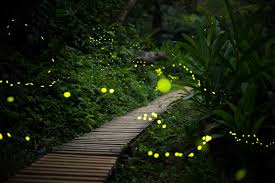
An example of intraspecific competition in fireflies is Photinus males imitating Photuris females that imitate Photinus males in order to scare off other Photinus males, reducing mating competition. The example of interspecific competition in fireflies is not so friendly. Photuris females mimic Photinus females to attract Photinus males. Instead of finding a mate, the Photinus males show up to a hungry Photuris female awaiting her meal. The biggest competition that exists within firefly populations are competitions between males for mates.

Resources are considered to be anything an organism interacts with that increases the growth rate of a population if it becomes more available. Renewable resources are constantly regenerated while nonrenewable resources are fixed at a certain amount throughout an individual’s lifetime. Liebig’s Law of the Minimum states that populations increase until the supply of the limiting resource prevents further growth. Fireflies are predators and are usually limited by habitat space. In order to increase the firefly population, one can stop using fertilizer that tends to eliminate insects or worms, decrease light pollution, and increase the amount of natural litter (plant growth, trees, etc) in an area.
The competitive exclusion principle states that two species cannot coexist indefinitely when they are limited by the same resource. If there are not enough resources to sufficiently supply two populations, one of those populations will go extinct. Following, the more closely related the two populations are, the more similar those populations are and the higher chance they will be competing for similar resources.
The logistic growth model can be altered to incorporate competition into the model:

Without going into too much detail, the population variable that directly influences the carrying capacity now includes a second population and how that population affects the first population. For example, if ⍺ = 0.25, it would take 4 individuals of species 1 to use the same amount of resources as 1 individual of species 2. This model is useful because it allows scientists to predict the outcome of competition.
In competitive circumstances, both populations can persist or one population will become extinct. Using the model above, initial conditions determine which species persists. If both populations start near the carrying capacity, it is likely that one population will go extinct, as the habitat can only provide enough resources for one of the populations. On the other hand, if both species start out with small populations, it is likely that an equilibrium will be reached. Coexistence is favored when each species persists at low levels of different resources.
There are three modes of competition: exploitative, interference, and apparent. Exploitative competition is when one population consumes the majority of an essential resource so much so that other populations can no longer persist. This type of competition is generally what is thought of as “competition.” Interference competition is when individuals defend resources from competitors and apparent competition is when two species compete due to the presence of a common enemy. Using the examples of interspecific and intraspecific competition from earlier, both situations are examples of exploitative competition. The males that mimic the flashes are lowering the number of females available for mating and the Photuris females that lure the Photinus males to their deaths are eliminating competition from the Photinus fireflies in general.
Allelopathy is the use of chemicals to interfere with their competitors. Fireflies contain defensive chemicals that make them predators avoid them. The predators are able to remember to avoid fireflies due to their luminescence.
 Lampyridae - Fireflies