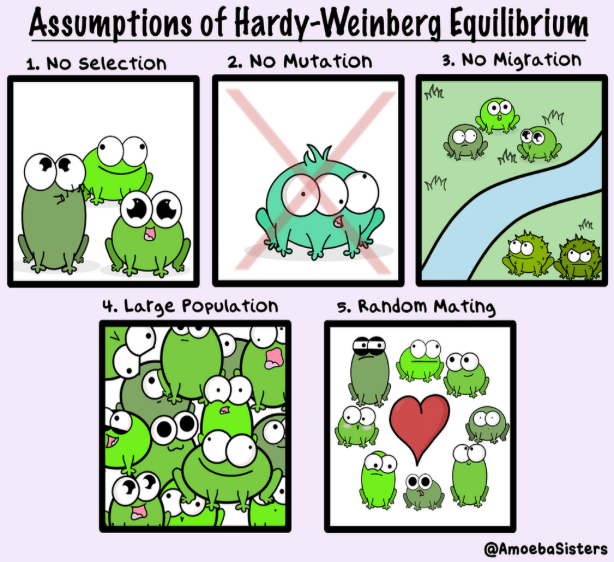
One of the most commonly used phenomena in evolutionary biology is Hardy-Weinberg Equilibrium. Hardy-Weinberg equilibrium describes how allele frequencies in a population will remain the same over generations without the evolutionary influence of factors such as natural selection if certain assumptions remain true as seen in the figure below.
The Hardy-Weinberg equation can be used to calculate the expected genotype frequencies for the next generation of a population given current allele frequencies.
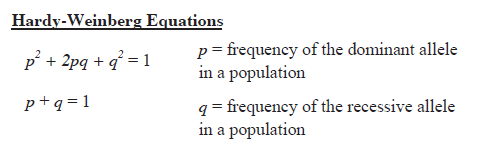
If these expected values are similar enough to the actual observed counts using a Chi-squared goodness of fit test, we can say that the population is in Hardy-Weinberg equilibrium. If the expected values are notably different, however, we can say that some form of evolutionary influence is taking place and at least one of the Hardy-Weinburg assumptions have been broken. Selection in populations is one notable way in which allele frequencies can change over generations.
Sexual selection is certainly present in some firefly populations. Specifically, Photinus, P. pyralis and P. macdermotti are two firefly species that have been studied for their unique sexual selection process. It has been found that female Photinus fireflies preferentially mate with males based on their bioluminescence pattern. Females favor males’ courtship signals with faster pulse rates. However, male signal attractiveness had little to no bearing on reproductive success and male paternity share as female Photinus fireflies mate with multiple males. So, males have evolved to produce varying spermaphore sizes and numbers to increase their chances of mating. Protinus fireflies deliver their sperm in bundles called spermatophores. Virgin males produce larger spermatophores, which contain more sperm, than males that have previously copulated. Males with relatively larger spermatophores have been shown to have higher fitness through increased paternity share regardless of whether they were the female’s first or second mate, increasing their likelihood of successfully mating. Females benefit from mating with males with larger spermatophores. It is thought that females that choose their mates based on spermatophore size might gain direct benefits such as improved fecundity and longevity.
Natural selection occurs due to a difference in the survival and reproductive success of phenotypes. Many different types of selection exist. To name a few examples, sexual selection occurs when individuals in a population pick mates based on traits. Selection follows because only the individuals with the desired traits reproduce. Only their genes get passed on to the next generation. Artificial selection happens when an outside influencer breeds another animal for a specific trait. Only the genes of the animals with the desired or most pure trait get passed onto the next generation.
Spermatophore size is also thought to be heritable. If phenotypes did not have a genetic basis, there would be nothing for selection to act upon, and the next generation of fireflies would have the same variation in spermatophore sizes as the previous generation. Natural selection does not have to occur for evolution to take place. Major events that affect allele frequencies cause evolution within a population. If a natural disaster were to take place in an environment that contained flightless and normal fireflies wiping out most of the fireflies able to fly because of a change in the atmosphere, evolution would occur since the fireflies that were able to fly, are no longer able to survive and reproduce relative to the fireflies that cannot fly.
There are different ways natural selection can affect the average of a trait. Selection can be stabilizing, disruptive, or directional. Stabilizing selection reduces the variance of the trait but the mean stays the same. In this case, those with more extreme phenotypes struggle to survive or reproduce. Disruptive selection is the opposite of stabilizing selection. While the mean stays the same, the variance increases. Those with average values of the trait struggle to reproduce favoring those with more extreme traits. Lastly, directional selection favors one extreme over another, changing the mean of the trait but the variance stays the same. For example, females of Protinus select males with larger spermatophores to mate with. Over time, we expect the size of the spermatophores to increase as larger spermatophore size confers greater paternity share. This sexual selection is directional since the females prefer males with an extreme trait.

All types of selection described above lead to microevolution: small changes in a population over a short period of time. Macroevolution describes larger scale changes such as the development of a whole taxonomic groups over a longer period of time. It is not known where exactly fireflies came from but it is thought that fireflies and click beetles, another luminescent beetle, acquired the gene Luciferase independently.
 Lampyridae - Fireflies