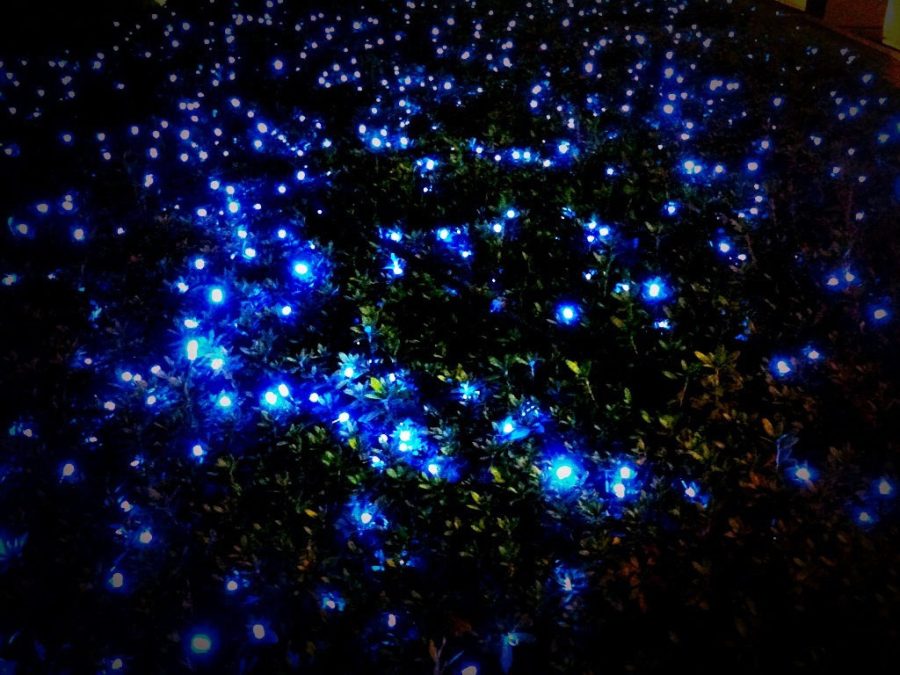
According to an Appalachian legend, the fireflies that glow blue are the ghosts of Confederate soldiers that passed in that area. This glow of Phausis reticulata can only be observed for a month during early summer as males search for females to mate. Males glow as they search for a female, releasing a sex pheromone that triggers the female to glow. This allows females to only glow for as short of a time as possible, to not attract predators, ultimately increasing their chances of reproduction and survival.

The survival and reproduction of an organism determines the continuation of the species. This is also known as an organism’s fitness. Phenotypes evolve because of the fitness a specific trait incurs over another trait. The higher one’s fitness, the more likely its genes are going to be passed on to the next generation. For example, females in the species Phausis reticulata glow blue for approximately a minute instead of flash and do not fly since they retain their larval form. Flying exposes the firefly to predators such as frogs and birds. Not being able to fly allows the female to stay hidden. Blue light is also harder to detect than other wavelengths. The cells in the eyes of an organism require more energy to detect the wavelength of blue light. This is because the lower the wavelength, the more energy is required to detect it. These two unique traits of these female fireflies allow them to survive longer and reproduce.
When animals as a species evolve over a large period of time, there are specific reasons why you don’t see some species such as fireflies become like eight feet tall. Evolutionary constraints determine relatively how big an organism can grow to or how many legs it can have. They are restrictions on behavior, morphology, and physiology on the evolution of an organism. A physical constraint is that fireflies cannot be larger than they are because they lack a closed circulatory system and rely on diffusion to transport oxygen and other nutrients to tissues.
Another type of evolutionary constraint is antagonistic pleiotropy. This occurs when one gene has a function that benefits an organism’s fitness and another function that hurts an organism’s fitness. The effects of the gene must be balanced and not too detrimental for the organism in order not to be selected against.
The last type of constraint we will discuss is evolutionary contingency. Broadly speaking, contingency refers to the chance that the evolutionary events played out as they did. If the history of life were replayed on earth, the biological forms of beetles, reptiles, mammals, etc., as we know today, may not exist in the replay. In another world, fireflies might breathe fire instead of glow. There are only certain outcomes an offspring can have based on the parents genotype. For example, fireflies can’t give rise to an organism that looks like a cat. The firefly is constrained to resemble their parents.
Adaptive fitness landscapes provide a visualization for the fitness of an organism with variations in two phenotypes. Fitness is shown through peaks. As seen below, only fireflies with certain combinations of color and ability to fly have higher fitness.

Constraints control which parts of the fitness landscape can have individuals. Individuals on the peaks tend to survive longer and have more offspring. A firefly that glowed blue and was able to fly might not be seen by males looking for a mate. These females would not have any fitness and are not shown as a peak on the adaptive landscape. Even though constraints limit the types of features organisms can have, bizzare traits exist in nature as a result of evolution.
 Lampyridae - Fireflies